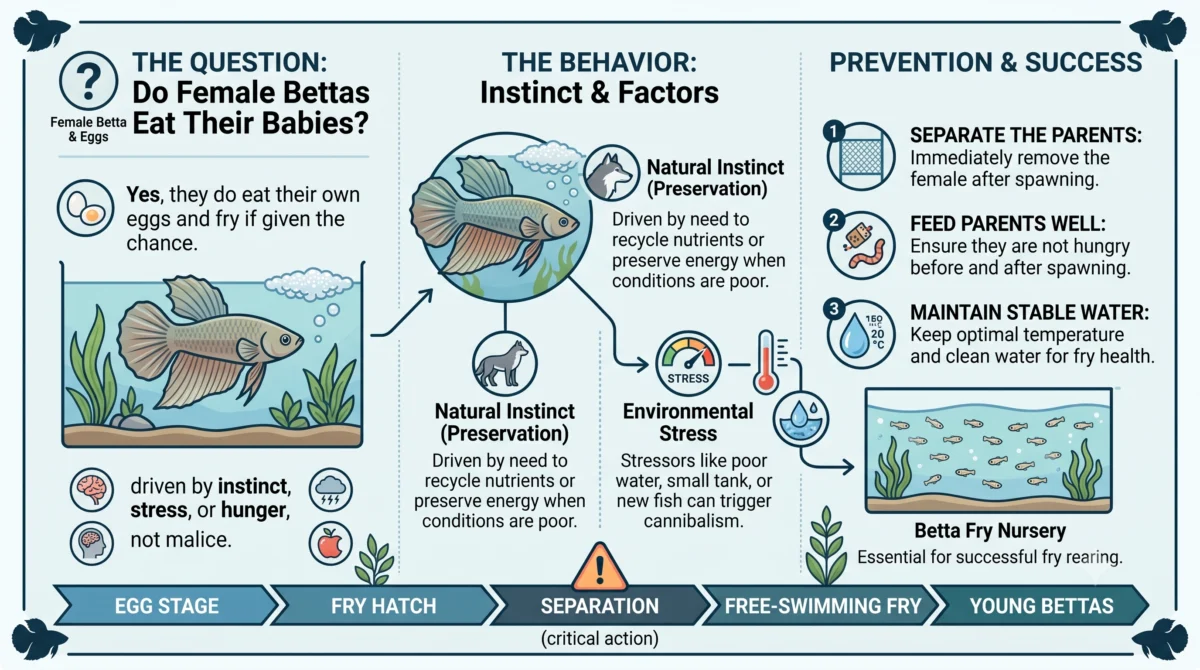
Yes, female betta fish do eat their babies. They will consume their own eggs and fry if given the chance. This behavior is driven by instinct, stress, or hunger, not malice. Understanding why and how to prevent it is essential for anyone hoping to raise betta fry successfully.
Do Female Betta Fish Eat Their Fry?
Female betta fish are known to eat their own fry, especially in captivity. Unlike males, who are the primary caretakers of the eggs and newly hatched fry, females have no parental instinct to protect the young. Once spawning is complete, the female’s role ends, and she often views the eggs and fry as food.
This is a natural survival mechanism, eating the eggs recovers energy spent during breeding. In a community tank, the risk is even higher because the female may compete with other fish for the easy meal. Removing the female immediately after spawning is the most reliable way to prevent this behaviour.
Why Do Female Betta Fish Eat Their Own Eggs?
The main reason is instinct. In the wild, betta fish live in shallow, nutrient-poor waters where every calorie counts. After laying eggs, a female invests heavily in energy, and eating some of the eggs replenishes her body for future spawns.
Stress also plays a role. In a crowded or poorly maintained tank, the female may perceive the eggs as a threat, if the eggs attract predators, her own survival becomes priority. Lack of hiding spots or insufficient food before spawning can trigger the same response.
The University of Florida IFAS Extension notes that betta fry are vulnerable to cannibalism under these conditions, reinforcing the need for a controlled breeding setup.
Do Male Betta Fish Also Eat the Babies?
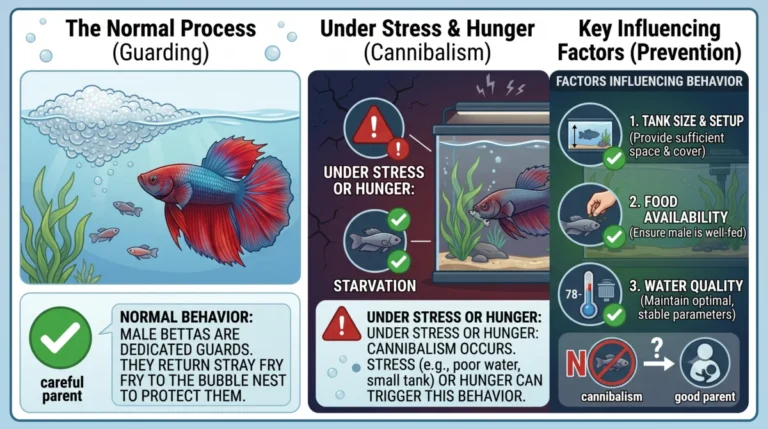
Male betta fish are far more protective of the eggs and fry. They guard the bubble nest, retrieve fallen eggs, and return fry that drift away. However, males can turn cannibalistic under stress.
If the male is young, inexperienced, or kept in a tank with poor water conditions, he may eat the eggs or fry. Hunger is another trigger, if the male has not been fed properly, he may see the fry as food. The difference is that male cannibalism is less common and usually has a clear cause, whereas female cannibalism is almost expected.
Removing the female and monitoring the male’s behaviour closely during the first few days after spawning is critical.
When Do Female Betta Fish Typically Eat Their Fry?
Female betta fish are most likely to eat the fry immediately after spawning and during the egg stage. Once the eggs are fertilised and placed in the bubble nest, the female often lingers nearby, picking off eggs she can reach. If she is not removed within a few hours of spawning, she will continue to eat eggs as they drop.
After the fry hatch and become free-swimming (around 3, 5 days), the risk decreases because the fry can scatter. But even then, a hungry female may chase and eat smaller fry. The critical window is the first 24 to 48 hours post-spawning, that is when the female must be separated.
How to Prevent Female Betta Fish from Eating Their Babies
The single most effective method is to remove the female from the breeding tank immediately after spawning. Do not wait until the eggs are laid, have a separate net breeder or another tank ready. Feed the female well before introducing her to the male so she is not hungry.
Provide plenty of hiding spots in the breeding tank, such as Indian almond leaves, caves, or dense plants, so the eggs and fry have cover. Lower the water level to 4, 5 inches; this makes it harder for the female to chase fry and easier for the male to guard the nest. Maintain stable water parameters (80°F, pH 6.5, 7.0) to reduce stress for all fish.
Setting Up a Separate Breeding Tank
A dedicated breeding tank is the best way to protect fry. Use a 5, 10 gallon tank with a sponge filter to avoid sucking up fry. Add a bubble nest site, a floating piece of styrofoam or a broad leaf, and live plants like Java moss.
Condition the water with Indian almond leaves to mimic the soft, acidic waters bettas prefer in the wild. Before introducing the pair, fast the female for 24 hours so she accepts food from the male during courtship. After spawning, move the female to her own tank.
Leave the male with the nest for 2, 3 days until the fry become free-swimming, then remove him too. This setup gives fry a safe start without parental interference.
The Role of Conditioning and Diet
A well-fed female is less likely to eat her eggs. Condition the female with high-protein foods, live brine shrimp, bloodworms, or daphnia, for at least two weeks before breeding. This ensures she has enough energy reserves and reduces the instinct to eat eggs for survival.
Feed the male the same diet to keep him healthy and attentive to the nest. After spawning, continue feeding the female generously in her separate tank. A hungry female that sees fry will almost always eat them.
Conversely, a female that feels full and secure is less aggressive toward the eggs. This is a simple but often overlooked part of successful betta breeding.
Recognizing the Signs of Spawning and Fry Presence
Watch for courtship behaviour: the male builds a bubble nest, and the female displays vertical stripes and a pale body. Spawning typically happens in the late afternoon. The male wraps around the female, squeezing out eggs, which he catches and places in the nest.
After spawning, the female lies still near the bottom or hides. If you see her actively picking at the nest or eating eggs, she is already eating the babies. Once eggs are fertilised, they hatch in 24, 36 hours.
Fry are tiny and translucent; they hang from the nest for the first few days. By day 3, they become free-swimming. At this point, remove the male to prevent him from eating them.
What to Do If You Find Baby Betta Fish in the Main Tank
If you discover fry in a community tank, act quickly. Use a turkey baster or a fine-mesh net to scoop the fry into a separate container filled with tank water. Do not pour them into fresh water, temperature and pH shock will kill them.
Set up a small hospital tank with a gentle filter and a heater. Feed the fry infusoria or liquid fry food for the first week, then graduate to baby brine shrimp. Do not put the female back in the same tank; she will continue to eat fry.
If the fry are too scattered to catch, leave them and hope some survive among the plants. Removing the female is the only long-term solution.
Do Female Betta Fish Eat Their Babies in a Community Tank?
In a community tank, female betta fish are even more likely to eat their babies. The presence of other fish, tetras, guppies, corydoras, adds stress and competition for food. The female sees the fry as easy prey, and other fish will join in the hunt.
Without a dedicated breeding area, only a handful of fry might survive if thick plants provide cover. If you want to raise betta fry, never rely on a community tank for breeding. The female will eat the eggs before they even hatch, and the male cannot protect the nest from dozens of other fish.
A separate breeding tank is non-negotiable.
| Parental Care Comparison | Male Betta | Female Betta |
|---|---|---|
| Guards bubble nest | Yes | No |
| Retrieves fallen eggs | Yes | No |
| Eats eggs/fry | Rarely | Commonly |
| Protects free-swimming fry | For 2–3 days | Never |
| Recommended removal after spawn | After 3 days | Immediately |
The table above shows the clear difference in parental roles. Male bettas take on the caregiving duties, while females pose a direct threat to the eggs and fry. Removing the female right after spawning is the single most important step.
Frequently Asked Questions About Betta Fish Cannibalism
Will a female betta eat her own eggs if she is well fed?
Even a well-fed female may eat eggs out of instinct. Food reduces hunger but does not eliminate the natural drive to consume eggs for energy recovery.
How long after spawning should I remove the female?
Remove the female within two hours of spawning. Waiting longer increases the risk of her eating eggs from the nest.
Can male betta fish eat their own fry?
Yes, but it is less common. Stress, inexperience, or hunger can cause a male to eat fry. Remove him after fry become free-swimming.
Do female betta fish eat the eggs in the bubble nest?
Yes, they target eggs that fall from the nest or those they can reach. The male often chases her away, but she will eat eggs when she gets the chance.
What should I do if my female betta is already eating fry?
Separate her immediately. Remove the fry to a separate tank using a turkey baster. Feed the fry microfoods and keep water clean.
Can I keep the female with the fry after they are one week old?
No. Female bettas still see fry as prey even after a week. The fry are small enough to be eaten until they are large enough to avoid being swallowed.
Is it safe to breed bettas in a community tank?
No. The risk of cannibalism from the female and other fish is extremely high. Use a dedicated breeding tank for any chance of success.
Related Posts