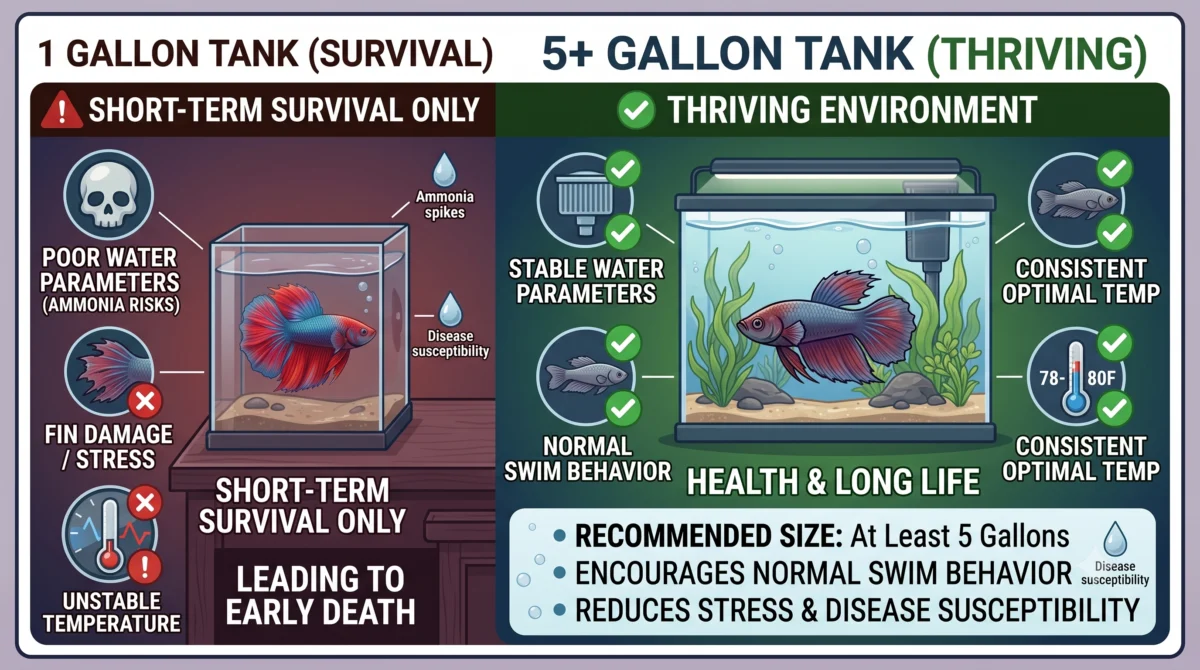
The short answer is no. A betta fish should not live in a 1-gallon tank. These fish need at least 5 gallons to maintain stable water parameters, swim normally, and avoid stress. While a betta might survive in a 1 gallon for a short period, survival is not the same as thriving, and long-term confinement leads to poor health and early death.
Why 1 Gallon Falls Short for a Betta
Bettas are labyrinth fish that breathe atmospheric oxygen, but they still produce waste that rapidly pollutes small volumes of water. In a 1-gallon tank, ammonia and nitrite levels spike within hours of feeding. Even with regular water changes, the biological filtration capacity of such a small space is almost nonexistent.
A healthy betta produces roughly 0.5 to 1 ppm of ammonia per day, depending on feeding. In 1 gallon, that concentration becomes toxic far faster than in a properly sized tank. The fish’s gills and skin burn from ammonia exposure long before you notice visible symptoms.
Stable water chemistry requires volume; 1 gallon simply does not offer the buffer necessary to keep parameters safe between changes. The result is a fish constantly fighting chemical stress rather than living naturally.
Water Quality Risks in a Miniature Tank
Ammonia spikes are the biggest threat, but they are not the only problem. Nitrate accumulation also happens quickly. Without a cycled filter, toxic compounds build up and force you to perform daily water changes just to keep the betta alive.
Even with meticulous maintenance, temperature swings become dangerous. A 1-gallon tank loses heat rapidly when the room cools, and heaters for such small tanks often malfunction or create hot spots. The smallest aquarium-grade heater available is typically 25 watts, which can overshoot in a 1-gallon tank and cook the fish.
Stable water quality demands volume and proper equipment. In a 1 gallon, you are fighting physics; every parameter drifts, every change is extreme, and the betta pays the price.
Space and Swimming Needs
A betta’s natural habitat includes shallow rice paddies and slow-moving streams, but those environments offer little lateral space to patrol. A 1-gallon tank, typically a cube or half-cylinder, provides less than 10 inches of swimming length. Bettas are active hunters and need room to stretch their fins, turn, and explore.
In cramped quarters, fin nipping, lethargy, and muscle atrophy become common. The fish also requires a horizontal surface area to rest near the top, a 1 gallon often lacks enough width for a betta to comfortably rest without pressing against the glass. Long-finned varieties like Halfmoons and Crowntails suffer even more because their heavy fins drag in such tight spaces.
Adequate tank size is not a luxury; it is a necessity for normal behavior.
Heating and Filtration Requirements
Bettas are tropical fish that require a water temperature of 78°F to 80°F. A 1-gallon tank cannot accommodate a reliable submersible heater without risking temperature spikes or total failure. Most heaters designed for 5, 15 gallon tanks are too powerful for 1 gallon.
The few models marketed for nano tanks are often unreliable, and the lack of filtration means you must manually remove waste.
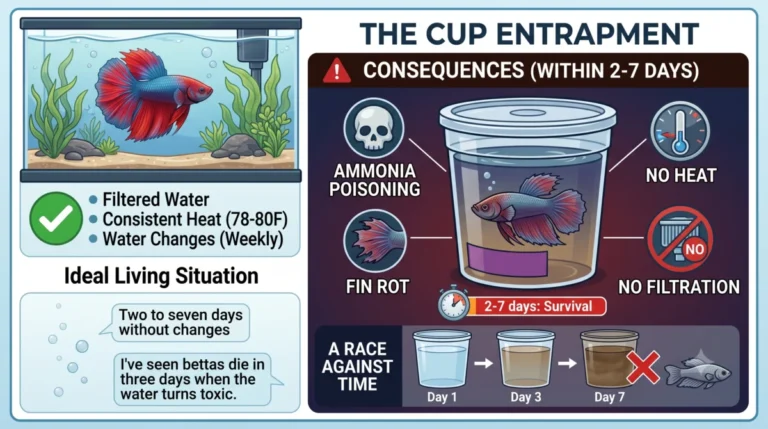
Unfiltered tanks demand 100% water changes every 1, 2 days, which stresses the fish and crashes any beneficial bacteria you might have cultivated. Without filtration, ammonia, nitrite, and nitrate accumulate between changes.
Even with daily maintenance, the lack of biological filtration means the water quality degrades faster than you can fix it. Proper heating and filtration simply do not exist in a 1-gallon ecosystem.
The Minimum Tank Size for Betta Fish
Aquarium experts and reputable betta care organizations consistently recommend a minimum of 5 gallons for a single betta.
The University of Florida IFAS Extension and many veterinary fish specialists agree that 5 gallons provides enough water volume to dilute waste, support a small filter, and maintain stable temperatures.
A 5-gallon tank also gives the betta room to swim, hide, and exhibit natural behaviors like bubble nest building.
Some sources suggest 2.5 gallons as an absolute bare minimum for a betta with heavy maintenance, but that size still falls short of long-term welfare standards.
The 5-gallon benchmark is based on practical experience: it is the smallest tank that allows for a cycled filter, heater, and predictable water parameters without the owner becoming a full-time water changer.
Can a 1 Gallon Tank Be Used Temporarily?
A 1-gallon tank might serve as a hospital or quarantine tank for a sick betta undergoing treatment, but only for a few days at most.
The small volume makes medication dosing easier, but the same volume makes waste buildup faster.
For a temporary setup, you must do 50% water changes every 12 hours and monitor ammonia closely.
Never use a 1-gallon as a permanent home. Some owners mistakenly think a betta “likes” small spaces because they see the fish resting near the surface.
In reality, the betta is conserving energy in a low-oxygen environment or trying to avoid polluted water lower in the tank.
A temporary stay of a week or less is possible with extraordinary care, but any longer invites irreversible organ damage.
Common Myths About Small Tanks
One persistent myth claims bettas live in puddles in the wild, so small tanks are fine. This is false. Wild bettas inhabit shallow but expansive floodplains, not drinking-glass-sized puddles.
Another myth says bettas get lonely in big tanks. Bettas are solitary and territorial; they do not crave company. A larger tank reduces stress because it offers more hiding spots and stable water.
Some owners believe a 1-gallon with a plant and daily changes is adequate, but that ignores the biological load. Plants help but cannot absorb waste fast enough in such a small volume. Finally, some argue that bettas “grow to the size of the tank.” This is not true, a betta’s growth is genetically determined, not tank-size limited.
Stunting is simply a fish sick from poor conditions, not a natural adaptation.
Signs of Stress in a Betta in a Small Tank
A betta confined to 1 gallon will show clear signs of distress. Look for clamped fins, where the fish holds its dorsal and tail fins tight against the body. Color fading is another red flag; vibrant blues and reds turn dull grayish.
The betta may hover at the surface, gasping for air, a symptom of low oxygen or high ammonia. Lethargy, loss of appetite, and refusal to build bubble nests indicate chronic stress.
Fin rot and white spots (Ich) appear quickly because the immune system weakens in poor conditions.
If you notice these signs, move the betta to a larger, cycled tank immediately. Even a 3.5-gallon bucket with a heater and air stone is better than staying in 1 gallon while you set up a proper tank.
What Happens to a Betta in a 1 Gallon Over Time
Over weeks, the fish experiences cumulative organ damage. Ammonia exposure causes gill inflammation, making breathing difficult. Chronic stress suppresses the immune system, so infections like columnaris or velvet set in.
The betta stops eating, loses weight, and becomes prone to dropsy, a symptom of kidney failure. After a few months in a 1-gallon tank, most bettas develop permanent fin damage from dragging on decorations or the glass. Lifespan plummets from a potential 3, 5 years to under a year.
Owners often blame the fish or “bad stock,” but the root cause is almost always the tank size. A betta in a 1-gallon is not living, it is slowly dying from environmental failure.
Better Alternatives for Betta Housing
The best option is a 5-gallon rectangular tank with a lid, a low-flow sponge filter, and an adjustable heater. Fluval, Aqueon, and Marineland all make affordable 5-gallon kits. For a budget-friendly alternative, a 10-gallon tank gives even more stability and room for live plants.
Avoid bowls, vases, and anything under 3 gallons. If space is extremely limited, a 3.5-gallon tank with a filter and heater is the absolute smallest I recommend, and only with rigorous maintenance.
Always cycle the tank fully before adding the betta, this means establishing beneficial bacteria that convert ammonia to nitrate, a process that takes 4, 6 weeks.
A properly cycled 5-gallon tank requires a 25% water change once a week, not every day.
How to Transition to a Proper Tank
If your betta currently lives in a 1 gallon, start by purchasing a 5-gallon tank, filter, heater, and water conditioner.
Set up the new tank and cycle it using an established filter media from a friend or a bacterial starter product.
Alternatively, do a fish-in cycle, which is stressful but manageable with daily testing and water changes.
Move the betta to a clean, dechlorinated holding container while you assemble the new tank. Float the betta in a bag in the new tank for 15 minutes to equalize temperature, then release it.
Expect the fish to be shy for a day or two; once it explores the extra space, color and activity will improve dramatically.
This is not a luxury upgrade; it is a rescue.
FAQ
Is a 1-gallon tank cruel for a betta fish?
Yes. A 1-gallon tank causes chronic stress, poor water quality, and stunted growth. It is widely considered inadequate by fishkeeping standards and contributes to a short lifespan.
How often should I change water in a 1-gallon betta tank?
You must change 50, 100% of the water every day or every other day. Even then, dangerous ammonia spikes still occur between changes.
Can a betta live in a bowl?
No. Bowls lack surface area for gas exchange, cannot fit a heater or filter, and trap waste. They are worse than a 1 gallon tank.
What size tank does a betta need to thrive?
A minimum of 5 gallons. This allows stable water conditions, proper heating, filtration, and room for swimming.
Do bettas get stressed in big tanks?
No. Larger tanks reduce stress by offering stable water and more space. Bettas feel secure with hiding spots and consistent parameters.
Can I put a betta in a 1 gallon hospital tank?
Only for a few days during treatment. Monitor ammonia hourly and do 50% water changes twice daily. Never use it as a permanent home.
Will a betta stop growing in a 1 gallon tank?
The fish does not stop growing; it becomes stunted from poor health. Organ damage and deformities result, not a natural size limit.
What is the easiest way to upgrade from a 1 gallon?
Buy a 5 gallon kit with a filter and heater. Cycle the new tank for at least 2 weeks using bottled bacteria or seeded media before moving the betta.