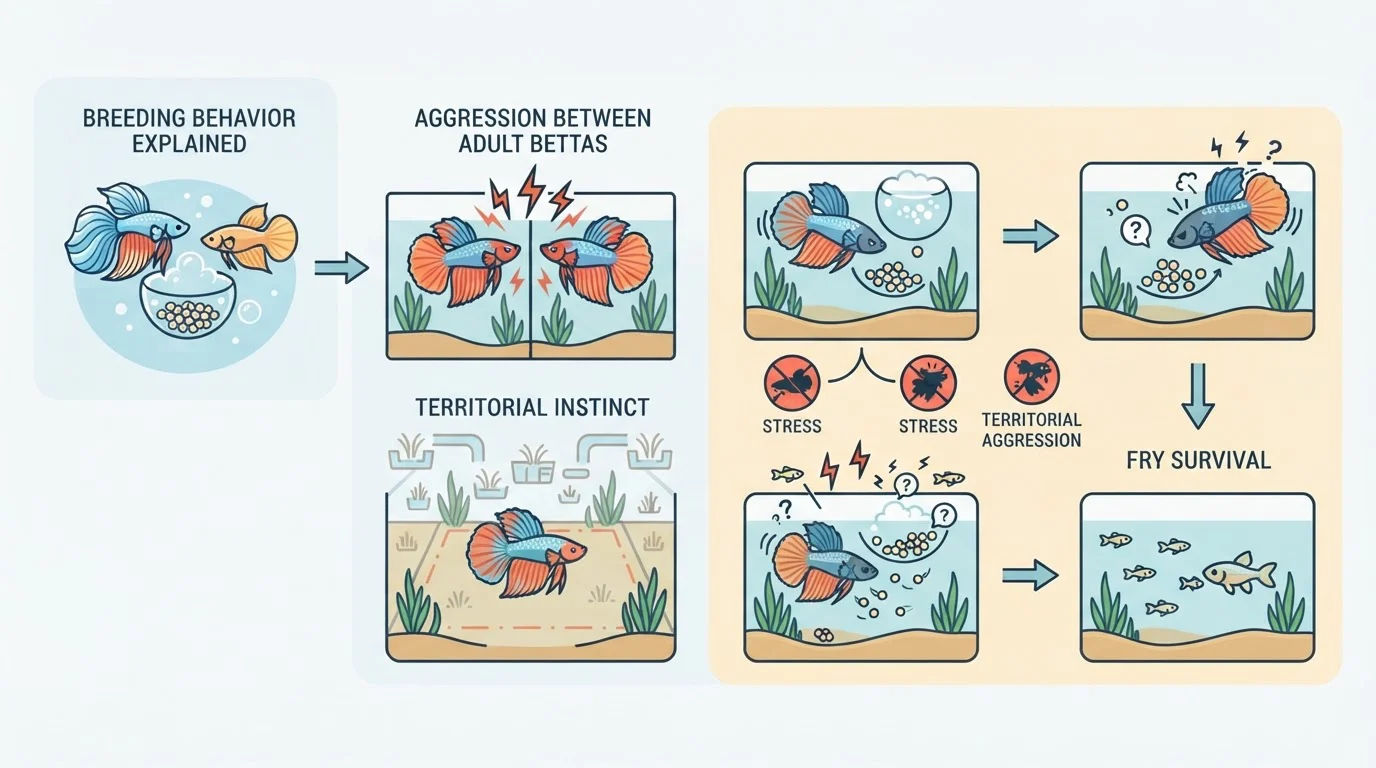
Betta fish sometimes eat eggs, fry, or each other, usually from territorial aggression or stress during breeding.
Aggression Between Adult Bettas
Fighting, not hunger, drives most conflict when two adult bettas share a tank. Territorial instinct, sharpened over generations in the wild, explains nearly every pattern covered in this section.
General Aggression and Mechanics
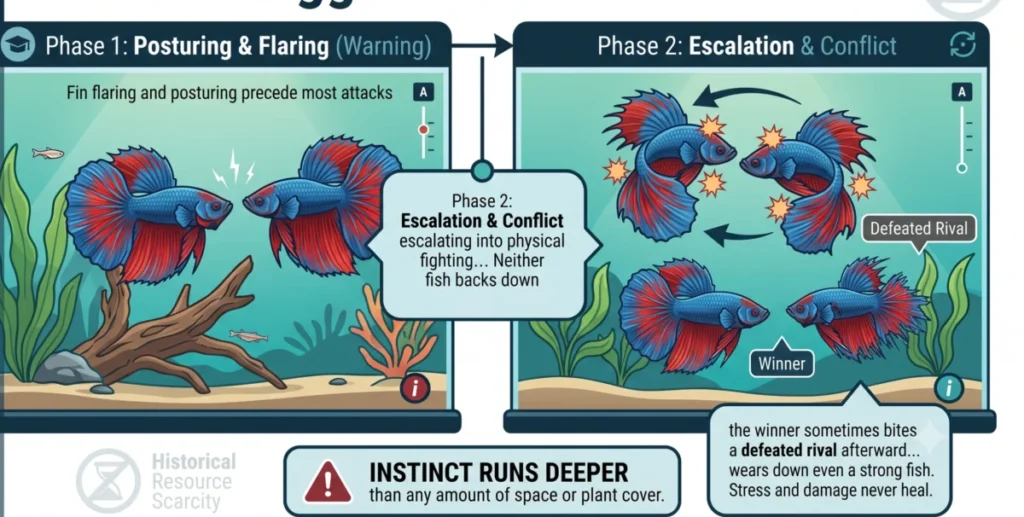
Housing two males together explains most cases of betta fish attacking each other. This risk stays present no matter how the tank gets set up. The instinct runs deeper than any amount of space or plant cover.
Fin flaring and posturing precede most attacks, escalating into physical fighting within minutes once neither fish backs down. Understanding how this fighting unfolds helps explain why the winner sometimes bites a defeated rival afterward. This surprises many first-time owners.
Bites typically land on fins and the body, rarely proving fatal in a single encounter. Repeated fighting over days, though, wears down even a strong fish. Stress and physical damage never get a real chance to heal.
Where This Instinct Comes From
Wild male bettas defend tiny territories in shallow rice paddies. Some guard a patch of water barely larger than a dinner plate. A rival male entering that space triggers an automatic fighting response. Countless generations of competition for breeding sites bred this instinct in.
This background explains why two calm-seeming males end up clashing eventually. Tank size and apparent peacefulness at the pet store rarely matter. Breeders selected for color and fin length, not temperament. This territorial drive never got bred out along the way.
Understanding this origin helps set realistic expectations. No amount of tank decoration substitutes for simply never housing two males together in the first place.
Killing Other Fish and the Root Cause
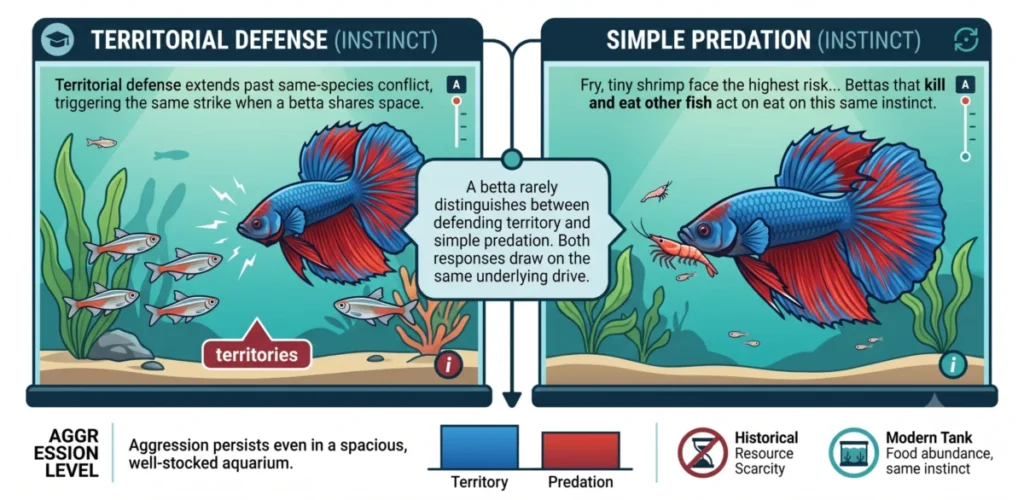
Territorial defense extends past same-species conflict too, showing up whenever a betta shares space with much smaller fish. Bettas that kill and eat other fish act on this same instinct. Non-betta tank mates that wander too close often trigger this same strike.
Fry, tiny shrimp, and other small, defenseless animals face the highest risk from this behavior. A betta rarely distinguishes between defending territory and simple predation. Both responses draw on the same underlying drive.
Tracing why this aggression happens always leads back to territorial instinct, shaped over generations defending scarce resources. Modern tank life removes the resource scarcity but keeps the instinct fully intact. Aggression persists even in a spacious, well-stocked aquarium.
Female-Specific and Cross-Gender Aggression
Gender shifts this pattern somewhat, since females and males show different aggression triggers and levels of intensity. Females fight less often overall but still carry real risk in the wrong setup.
Female Aggression Toward Other Females
Crowded groups lacking enough space explain most cases of female bettas fighting each other. Sororities work far better once the group grows past four or five fish. Aggression spreads more thinly across a larger number.
Fewer hiding spots and dense plant cover both raise conflict risk considerably. A tank stocked below this minimum group size often sees one female targeted repeatedly. Breeders call this pecking-order bullying.
Cross-gender pairing raises a separate concern entirely. Females attacking male bettas outside a supervised breeding attempt happens more often than most new owners expect. This grows likelier once a female claims her own territory.
Female Aggression Toward Tank Mates
Territorial drive extends past other bettas too, showing up whenever a female shares space with smaller fish. Females preying on tank mates follows this same instinct. Anything small enough to seem like easy prey stays at risk.
Size decides most outcomes with invertebrates specifically. Female bettas eating snails follows a similar size-based pattern covered in our compatibility guide. Smaller or younger snails face real risk; larger, established ones stay mostly safe.
This pattern holds true regardless of how calm a particular female seems day to day. Individual personality varies, but the underlying instinct stays present in nearly every fish.
Male Aggression Toward Females
Breeding attempts carry their own distinct risk profile, one worth understanding before pairing any two fish. Male bettas attacking females outside controlled breeding confirms real danger. Males show unpredictable aggression toward females introduced without proper preparation.
A poorly timed introduction, rushed without conditioning both fish first, raises this risk considerably. Breeders typically separate the pair immediately after spawning finishes, removing the female before any lingering aggression turns serious.
Fin Biting, Tail Biting, and Odd Self-Directed Behavior
Several patterns relate to bettas targeting their own body or tank items rather than genuine food. Stress, boredom, and poor water quality explain nearly every case covered here.
Fin and Tail Biting
Stress explains this behavior better than hunger does in almost every documented case. A compulsive, stress-related habit describes what looks like bettas nipping at their own fins, not intentional self-harm.
Poor water quality, boredom, or an underlying health issue often triggers this pattern together. Testing ammonia and nitrite levels rules out the most common physical cause quickly. Only then does stress become the likely answer.
Adding a few floating plants near the surface gives a bored betta something new to investigate. This simple change resolves fin biting in many cases without needing any medical treatment at all.
This exact fin-biting pattern explains bettas biting their own tails too, worsened by boredom or poor water. Fin regrowth typically follows once the stressor gets addressed, though full recovery often takes several weeks.
Investigating Their Own Waste
Curiosity, not appetite, explains most of this next behavior entirely. Investigating particles near the substrate, without genuinely consuming them, describes bettas mouthing their own waste fairly accurately.
This incidental, exploratory habit answers why this poop-related behavior happens in most tanks. No nutritional need drives it. Regular gravel vacuuming during water changes reduces how often owners even notice it.
Rocks and Self-Directed Behavior
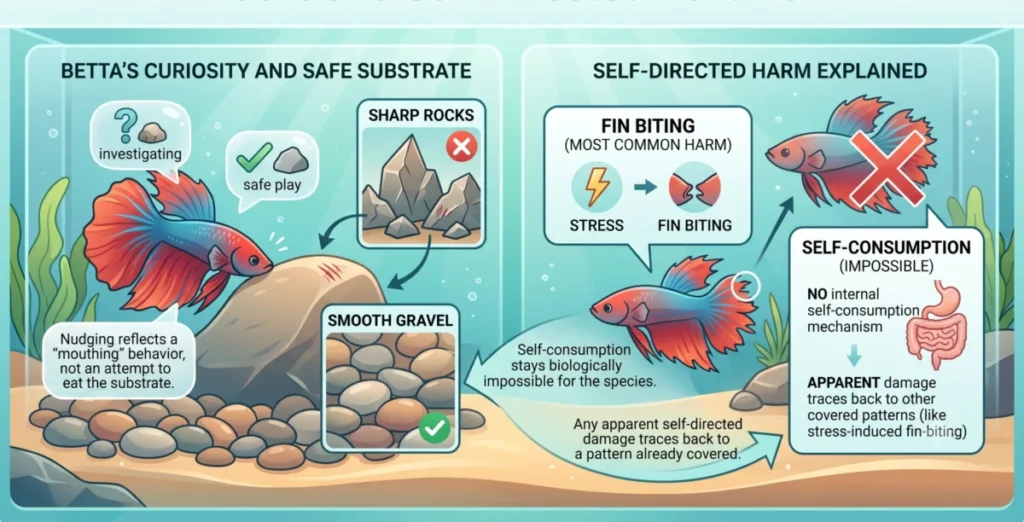
Substrate sometimes draws this same curious attention too. Bettas nudging tank rocks reflects this identical mouthing behavior, not any real attempt to eat the substrate itself.
Choosing smooth, appropriately sized gravel prevents any accidental injury during this kind of investigation. Sharp or oversized decor pieces occasionally cause minor scrapes when a betta pushes against them repeatedly.
Fin biting once again explains most cases people describe as bettas harming themselves directly. Self-consumption stays biologically impossible for the species. Any apparent self-directed damage traces back to a pattern already covered.
Eating Eggs and Fry During Breeding
This topic carries the most emotional weight for many owners, especially first-time breeders working at home. Stress, inexperience, and normal nest instinct explain nearly every case covered below.
Eating Babies and Fry
A well-documented pattern among stressed or inexperienced parents describes bettas eating their own fry. Many first-time breeders expect a purely protective parent instead. Even experienced pairs occasionally show this behavior during a particularly difficult spawning attempt.
Nest-maintenance instinct, stress, and simple inexperience work together to explain why fry get eaten in most cases. A parent still learning proper nest care sometimes struggles to tell healthy fry from weak or dying ones.
Female and Male Specific Fry Eating
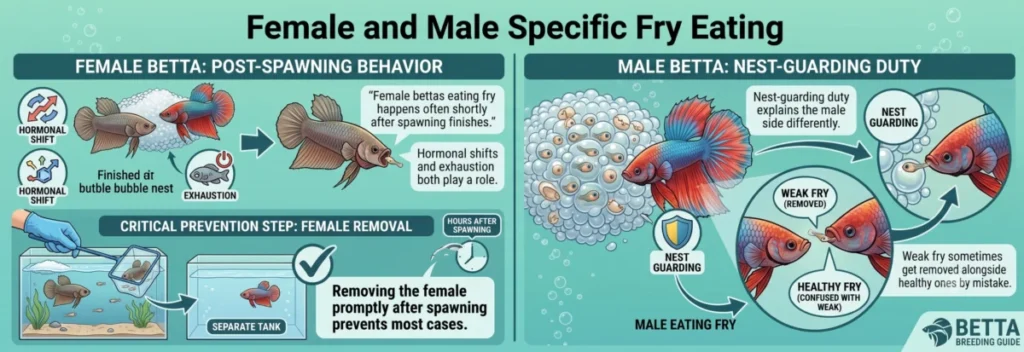
Post-spawning behavior explains the female side of this pattern fairly directly. Female bettas eating fry happens often shortly after spawning finishes. Hormonal shifts and exhaustion both play a role in this window.
Removing the female promptly after spawning prevents most cases of this specific behavior. Many breeders treat this step as non-negotiable. She moves to a separate tank within hours of the eggs being laid.
Nest-guarding duty explains the male side quite differently. Male bettas eating fry happens through this same duty gone slightly wrong. Weak fry sometimes get removed alongside healthy ones by mistake.
A Note on Bubble Nests
Days before eggs even arrive, males build elaborate bubble nests at the surface. Saliva-coated bubbles hold together remarkably well. This nest becomes the central site of nearly every egg-related behavior covered throughout the rest of this section.
A healthy, actively maintained nest signals a male ready and willing to guard eggs properly. A neglected or abandoned nest, by contrast, often predicts poor parenting outcomes ahead. This gives breeders an early warning sign.
Eating Eggs in General
Nest maintenance drives much of this behavior, more than genuine appetite ever does. Removing unfertilized or fungus-affected eggs, as routine care, describes bettas eating their own eggs in most documented cases.
This same mix of stress, inexperience, and instinct answers why eggs get eaten across nearly every attempt studied. Distinguishing viable eggs from spoiled ones takes practice. Even skilled males occasionally misjudge a healthy egg during this sorting.
Female-Specific Egg Eating
Timing plays an outsized role for females specifically, more than any other single factor. Female bettas eating their eggs centers heavily on the period right after spawning. This pattern shows up across breeding pairs of every experience level.
Removing her promptly, right after spawning finishes, answers why females eat eggs as far as prevention goes. This single step protects the remaining clutch and lets the male take over guarding duties undisturbed.
Preventing Egg Loss
A quiet, low-disturbance tank supports successful guarding more reliably than almost any other single factor. Understanding when bettas leave eggs safe and uneaten points directly toward this calm environment. Sudden noise, light changes, and needless tank maintenance all work against it.
Minimal handling and consistent water conditions both support a calmer, more attentive male throughout this sensitive window. Even experienced breeders still expect some natural egg loss. A perfect outcome stays the exception, not the rule.
Reducing Risk in Everyday Tank Setups
A few general habits reduce the odds of encountering this behavior in a typical tank. Prevention rests almost entirely on housing choices made from day one.
Serious conflict between two males rarely gets prevented by even the most spacious, well-planted tank. Never housing two males together remains the single most effective preventive step available to any owner.
Spreading aggression more evenly across several fish works far better than a small, crowded group. Female sororities do best with a larger group and a genuinely bigger tank from the start. Dense plants and visual barriers give individual fish real places to retreat.
More erratic feeding habits and higher overall aggression both show up in stressed fish dealing with poor conditions. Water quality plays this same supporting role throughout nearly every pattern covered in this guide.
Bringing It All Together
Territorial aggression between adults, or breeding stress, explains nearly every behavior covered throughout this guide. Neither pattern reflects any flaw in the fish itself or in the owner’s care.
Compatibility principles that make conflict less likely get covered in full in our betta tank mates guide.
Frequently Asked Questions
Does removing the male after fry hatch help?
Yes. One main remaining risk to fry survival disappears once the male gets removed after they turn free-swimming.
Do first-time breeding pairs improve with experience?
Often, yes. Less egg or fry loss tends to show up on later attempts as both fish grow more experienced.
Is fin biting ever a sign of illness rather than stress?
Occasionally. A closer look beyond simple stress becomes worthwhile whenever fin damage persists alongside symptoms like lethargy.
Should two male bettas ever share a divided tank?
A solid, opaque divider tends to work better than most alternatives. Any visible contact through it still risks ongoing stress for both fish.
Does overcrowding trigger more aggressive egg or fry eating?
Yes, indirectly. Stress levels rise overall in crowded or poorly planned tanks. This raises the odds of this behavior showing up.
Is losing some eggs normal even in ideal conditions?
Yes. Some loss happens even with experienced parents working in a calm, well-set-up breeding tank.
Does water quality affect egg-guarding behavior specifically?
Yes. A male becomes more likely to disturb eggs he’d otherwise guard once poor water quality adds extra stress.
Does a betta’s individual temperament predict this behavior?
Somewhat. Less egg or fry eating shows up in calmer, experienced individuals, though no single fish stays entirely predictable.
Does relocating a tank trigger this behavior outside breeding?
Yes, sometimes. Stress rises whenever a tank gets moved or water changes happen suddenly. This sometimes shows up as aggression toward tank mates.
Does diet quality reduce aggressive behavior?
Somewhat. More stable behavior shows up in a well-fed betta than in one facing poor nutrition and other stressors.
Do experienced breeders avoid egg or fry loss entirely?
Rarely. Some natural loss stays a realistic part of the process, even for the most experienced breeders around.
Does tank lighting affect how calmly a male guards the nest?
Somewhat, yes. Extra stress during this sensitive period tends to come from overly bright or inconsistent lighting overhead.
Does the male ever destroy his own bubble nest on purpose?
Rarely. Maintaining and repairing the nest, rather than destroying it, describes typical male behavior. Only sharply rising stress changes this.